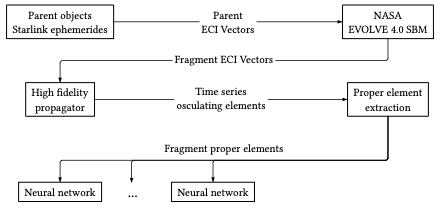
Classification of LEO debris family. The use of proper elements to reconnect families of satellite fragmentation debris has seen recent development with the emergence of machine learning in novel techniques. However, a constantly evolving circumterrestrial environment may limit applicability of these techniques in cases where the non-linear thresholding learned in neural network models is skewed by its training on outdated representations of debris in orbit. In this work, a computational pipeline is devised and tested in a controlled environment to evaluate current classification techniques and suggest future directions. Synthetic fragmentation data was generated using a Standard Breakup Model and propagated under a high-fidelity dynamical model. Proper elements were then extracted based on modified equinoctial elements, Poincar´e elements, and the quaternion set, and classified using a neural network to reconstruct the debris families. After modifications to the feature set available to the neural network were made, classification performance was increased.