Technical session featuring concise, focused presentations delivering practical insights and current research across positioning, navigation, and timing (PNT), including lunar navigation orbit determination and time synchronisation.
I served as facilitator and speaker for the Lunar Navigation session at PNT 2026.
Facilitator:
Speakers:
This technical session features a series of concise, focused presentations delivering practical insights and current research across positioning, navigation and timing. Each speaker presents within a short time allocation, allowing a broad range of topics, case studies and technical approaches to be covered in a single session.
Session start time: 1:30 PM.
Mr Rameez Ahmed Malik
PhD Scholar, UNSW Sydney
Title: GNSS Based Orbit Determination of Lunar Navigation Satellite System
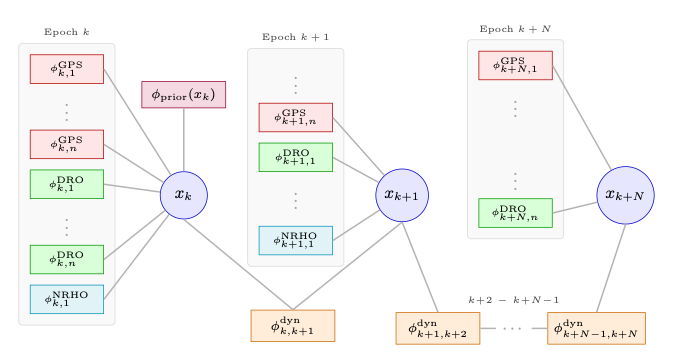
The development of an indigenous Lunar Navigation Satellite System (LNSS) is a critical enabler for sustained lunar presence and autonomous operations supporting future lunar base architectures. The performance of such a system is fundamentally dependent on the accuracy of the LNSS satellite ephemerides and clock synchronization. Errors in the estimated ephemerides or clock synchronization directly propagate into user positioning, navigation, and timing (PNT) solutions, thereby degrading service integrity. Conventional ground-based orbit determination relies on Earth-based tracking networks, which are limited by geometric constraints, intermittent visibility, and communication gaps, making continuous and accurate ephemeris computation challenging for lunar satellites.
To overcome these limitations, this study investigates the feasibility of exploiting Global Navigation Satellite System (GNSS) sidelobe signals for LNSS precise orbit determination under various sensitivity bounds. Although the main-lobe coverage of GNSS constellations does not extend to lunar distances, several studies and in-flight missions have demonstrated detectable GNSS sidelobe signals in the cislunar region. By leveraging these weak but persistent signals, LNSS spacecraft can perform autonomous or hybrid orbit determination independent of continuous Earth-based tracking, thereby enhancing orbit recovery capability.
The results demonstrate that GNSS-based precise orbit determination enables accurate and continuous orbit recovery for LNSS spacecraft, significantly improving ephemerides precision in the absence of constant ground-based visibility. The proposed framework establishes a robust methodology for autonomous, high-accuracy orbit determination of LNSS constellations, contributing to the realization of a sustainable and resilient lunar navigation infrastructure.